
By Billy Metcalf
© 2000
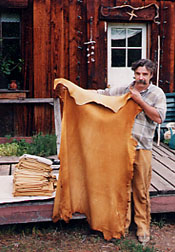
As a full time time brain tanner who tans a hundred or more hides a year, I’ve developed a system for tanning deer hides that gives me the results I’m looking for consistently, hide after hide. But even after fifteen years I still find tanning big hides like Moose or Elk to be a real challenge. In the last year I’ve tanned three Elk and two Moose. They all came out good with varying degrees of difficulty. I’m starting to put together a system though that seems to be working out. So, far from being an expert, I’ll share what I’ve learned and hopefully it will help some of you when you decide to tackle one of the big hides. I’ll assume that you already have a basic knowledge of brain tanning, the steps and terminology, as Matt Richards describes in his book, “Deerskins into Buckskins“.
The essential element when it comes to doing big hides is hard work. Everything about it is harder than tanning a deer. The last Moose I did was an eighteen month old bull. Our Moose season here is for bulls with no more than two points, which pretty much means it’s their first set of antlers. This ‘small’ bull hide was 25 sq. ft. when finished and 1/4″ thick on the rump. When these hides are soaking wet with the hair on they can weigh 150 lbs or more.
First off, I’d recommend getting proficient at tanning deer before trying a Moose or Elk. Next, try to get a cow or young bull hide for tanning. The big old bulls are impressive but don’t really lend themselves to making garment grade buckskin. Wes Housler talks about this in regards to tanning Buffalo robes in his video. I’ve been doing the wet scrape method, so that’s what I’ll talk about first, although I have an idea about incorporating dry scraping into my technique.
This young bull Moose that I just finished had been stored salted and rolled up in a plastic garbage can for over a year. So the first step was to scrape off the salt and soak it in water for a couple of days. It was fairly flexible, not hard to unroll before I put it in the water. I fleshed it on an upright beam with a fairly sharp drawknife. Moose have a much tougher membrane layer than deer, that has a cross hatch of sinewy stuff that allows them to twitch their skin like you see horses doing to get rid of flies. I tried to get as much of this as possible but figured I’d get the rest when the hair was gone. Fortunately because this hide had been stored for so long the hair was falling out by the time I was done fleshing. So I turned it over and took the hair off with the back of my draw knife. Even though I still had to get the grain off, removing the hair greatly reduced the weight and bulk of the hide.
Because I don’t measure things much I can’t say how strong I made my lye solution but I did make it somewhat stronger than I do for deer. Also I’ve found that with these big animals, they need to soak in the lye for twice as long as a deer would. I left this Moose in for six days and it probably could have stayed a couple more.
Wet scraping this hide was difficult. The dull draw-knife that I usually use on deer was brutally slow. I resorted to my sharp bladed draw-knife that I fleshed the hide with. It was tricky because with the hide swollen from the lye it would roll in front of the blade causing the sharp blade to dig in. The grain on these hides is thick and I have to go over a lot of it twice to get it all. Most deer take me 45 minutes to an hour to grain, this Moose took four hours.
I neutralize my hides in a tub with a hose running into it. Twenty-four hours usually does it with deer hides. This Moose took a full 48 hours, and I left it in for another 12 hours to be sure. The thing with these thick hides is that they can have a look and feel you want on the surface when the middle isn’t there yet. So buck extra long and neutralize extra long. You don’t want to try to brain the hide if it’s not totally neutralized.
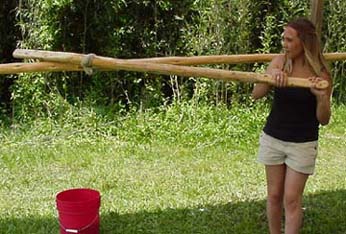
Wringing can be a real workout. I use the twisting with two poles method. With a three feet long hickory maul handle for a twister I put all of my six foot tall 190 lbs. into it. A longer handle might be in order for big hides like this, especially for a smaller person. It just won’t get as wrung out as you’re used to with deer, but give it your best try. I brained my Moose in the morning and took it out again after supper, wrung it out while the brains were warming up, and brained it again.
I left it in the brains over night and took it out in the morning. I wrung it out to try to get as much water out as I could and laced it into a frame. I laced the hide tight but after going over the whole hide with my trappers trowel it had loosened up some. I left it this way until it got so baggy that I couldn’t really work it right. This is how I soften my deer hides too. I can get those fibers moving around a lot better with the hide loose than if I keep re-tightening it.
For some reason no matter what the weather has been like up until then if I want to soften a Moose it turns cold and rainy the day I’m doing it. So I had to be indoors. I put a fan on it and things were looking good for getting it done by bedtime, but like I said before, a thick hide can look good on the surface when it’s not there yet in the middle. So after getting started by nine that morning, I finally had to go to bed at 1 a.m. and the hide wasn’t dry yet. I had a fan blowing on it all day but the cool rainy weather had really slowed things down.
This wasn’t constant working. I smoked some hides, fleshed a deer hide and grained another, went to town and worked on my new porch that day too. Stretching the hide with the trappers trowel when it started to stiffen a little, then leaving it to dry some more between stretchings. I stapled plastic on both sides of the frame and went to bed.
The next day I took the plastic off and continued working the hide. By that afternoon it was dry and had come totally soft except for the hump. Moose have a hump like a Buffalo and it is the toughest part to soften. That’s why I thought maybe I could’ve left it to buck longer. I don’t know if that would have made the hump soften the first time or not. It seemed as though the brains had not penetrated well enough there. Even when it was still wet there was no stretch in that hump area. (Editor’s note: when I’ve done Moose the hump has been super hard to get soft too).
A couple of days later I sewed the hide up into a bag and smoked it. I had the brains heated up and put the hide straight into the brains after smoking. I took the hide out after an hour or so and cabled the parts that weren’t soft enough until there was white foam coming out, then put it back in the brains. The next day I wrung it out and laced it back in the frame and let it start drying. Only when it seemed to be drying enough to start to stiffen did I go over it with my trappers trowel. I paid close attention to the hump because this was the area I really wanted to get soft. The rest of the hide was soft enough from the first softening. The hide took all day to dry with the fan blowing on it again but this time the hump came soft. I now have a very soft, with no stiff spots, 25 sq. ft brain tanned, smoked Moose hide.
One of the most important things for me in recent years has been bucking (soaking the hide in alkali). I successfully tanned hundreds of deer hides without bucking but I never made garment quality buckskin from Moose or Elk before I started bucking the hides. It was just too labor intensive and I could easily do three deer with that time and effort. Having said that, I’m starting to realize that the real benefit to bucking big hides is in better brain penetration. Not so much or maybe not at all in easier graining. With these thick hides they may already be thick enough to grain just as easy before bucking. Like I said before, if the hide is too swollen it rolls in front of the blade. A dull blade doesn’t do anything and a sharp one digs in. So in some cases it may be just as easy to grain before bucking, then membraning the hide afterwards will squeegee out some of the mucus or ground substance before rinsing. Also I’ll try leaving the hide in the lye for a longer period of time.
Re-braining after smoking is a great thing to know about for doing these big hides. It’s so much more relaxed and efficient than re-braining a white hide and having to work the whole thing out again. I can concentrate on the area that needs more work and just move the rest around to keep it soft. The areas that came soft the first time will come soft again with very little effort.
I have one more idea about doing big hides that I have yet to try. I think the lye solution could start out the same strength as when bucking a deer. Then after graining put the hide back into a stronger lye solution for a few more days. The lye would work it’s way into the middle of the skin quicker after the hair and grain are removed.
If it’s at all possible to predict the weather, try to soften big hides on a warm sunny day, with a light breeze. They are thick and will test your endurance. The time when they seem to be almost done really drags on compared to a deer skin, especially on a cool damp day.
|
Key Tips for Big Hides -Do a deer first and expect to work harder. |
Being a full time tanner, I can’t always get right on a hide when it’s fresh, so I have to salt them and store them until some other time. Which means re-hydrating in water, and having to drag a sopping wet 150 lb. Moose hide to the fleshing beam. For a smaller person this could be much more than just inconvenient. Also the amount of upper body strength needed for wet scraping the grain could be prohibitive for a smaller person.
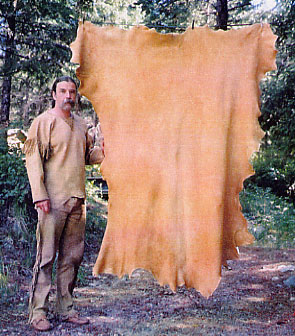
My ideas for dealing with big hides for small tanners are first, flesh them while they are fresh. That way you’re not heaving that heavy wet hide around to the fleshing beam. Then string it up on a frame, dry it and dry scrape it. This way a smaller person is at no disadvantage when it comes to graining. Then you can re-hydrate the hide and buck it in order to get the benefit of the increased brain penetration. For wringing, a longer handle for twisting will give better leverage.
When it comes to softening there’s not much that can be done to level the playing field for a smaller person. I rely on my weight to lean into those hides quite a bit. I definitely recommend frame softening for a small person. Cabling 25 sq. ft of thick Moose would wear me out in no time.
I hope that my experiences have helped some of you who want to tan a Moose or Elk. My goal here is to provide some encouragement and maybe some tips to help you work with these big beautiful hides. Good luck, and remember, it takes brains to make buckskin!