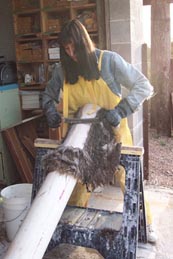
Erin is removing the hair and grain from her hide with a draw-knife over a pvc beam. I'm not sure if she has the beam anchored to the saw-horse, but it would really help keep the beam stable...and make the work easier.
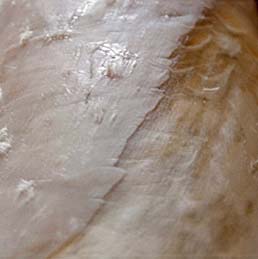
Here's a great close-up (from Bob Kurasawe) of the swollen grain one gets when soaking hides in alkali (wood ashes, Red Devil lye, or hydrated lime). The section on the left has the grain intact, on the right it is removed. If you use good technique and are careful to scrape each area thoroughly before moving on, you get a good crisp transition line like this. It makes it very obvious what still needs scraping, and it makes it easier to do.
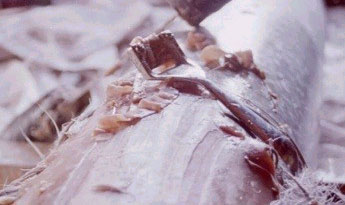
Bob Kursawe says that using a "skiving" knife to scrape the grain off of hard necks is "not much more difficult than peeling taters". You can get these tools through Tandy and other leathercraft suppliers.
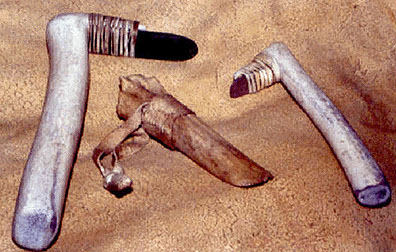
These ones are made, used and sold by Chris Hanson Left to right...elk antler scraper with steel blade, buffalo legbone flesher with sinew sewn braintan leather lanyard and small elk antler scraper with flint blade.

The shear joy of wet-scrape! (notice the ever present and useful five gallon plastic buckets strewn across the background)
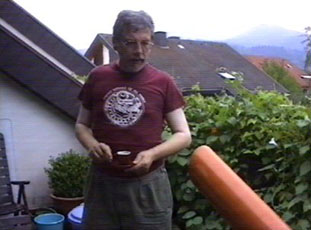
Everybody needs a break from scraping so why not have an espresso with Georg Barth, author of Native American Beadwork, on the balcony of his third floor condo in Kirchzarten, Germany (a small town near Freiburg in the Black Forest region). Notice the beautiful color of his PVC beam and its height in relationship to his chest. He (and others) says this makes for very comfortable scraping without needing to stoop as much.
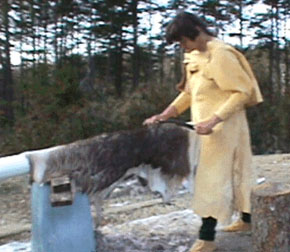
I'll bet my last buckskins that she wears something over that dress when she's scraping!
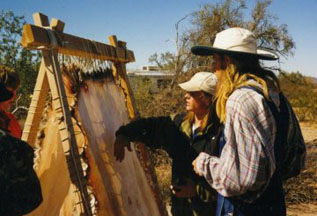
Notice how the two frames are attached together to form an A-frame. This is a simple way to make self-supporting frames that can be moved around on the open ground.
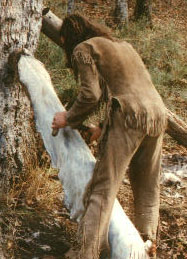
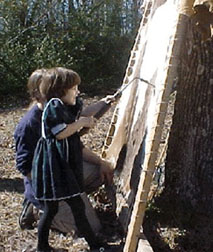
The beam is leaned against a tree and the hide is pinned between the tree and beam. You scrape by pulling the tool toward you. Sheom's buckskins have been dyed with Black Walnut hulls to give them that deep brown color. He wouldn't need to stoop so much if he leaned the beam higher on the tree.
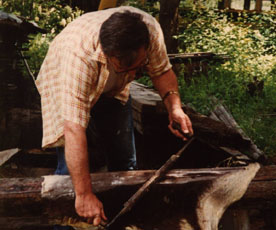
Jack is the owner of the Thompson Conservation Labs, a business dedicated to the understanding of ancient leathers and parchments.